4 Cozy Reading Nooks You’ll Want in Your Home Right Now Constructing a reading nook doesn’t have to be hard. Sometimes all you need is lots of pillows and a little unused space. Reading nooks are also a great way to use dead, unused, or awkward space within a home. Nooks can help maximize living space and provide additional seating, along with providing a personal sanctuary. With these four easy DIY reading nook projects, it won’t be long before you find yourself dreaming of getting lost in a good book. 1. Make Use of Dead Space with a Corner Bench Do you have a dead corner in your house that’s just…there? A great remedy for that empty space is a corner bench. Creating an L-shaped bench will maximize your space. Not only will it provide additional seating, but it can also become storage. Create this bench with bookshelves, cushions, and pillows for the ultimate reading nook space. When the bookshelves are placed together, you can then determine what size cushion you will need to go on ...
FACE MASK SEWING PATTERN

Materials
- Main Fabric (cotton), 13" x 7", prewash
- Lining Fabric (cotton or flannel), 12" x 7", prewash
- Bias Tape, 2" wide 6" long (5" for young kids, 4" for small kids), prewash. (Optional, as nose wire sleeve)
- Wire, 6" (5" for young kids, 4" for small kids). (Optional, as nose wire), bent the ends inward so the won't poke through the fabric.
- Elastic cord: for ear loops, 8" x 2, or, for a head tie, 18" x 1, (this is an approximate length, please measure with your own elastic band to judge; as everyone's head and sizes are different)
- or, shoelace/ribbon/cord/t-shirt yarn with at least 44" length for the head tie
- Face Mask Sewing Patterns; Choose your option to download and print separately
Tools
- Sewing essential
- Sewing Machine or hand sew
- Iron
- Seamstress tracing wheel and paper
- Pencil or soluble fabric marker
Instructions
- Decide which type and size you want to sew, choose the correct pattern from the list, download and print out the template of Face Mask Sewing Pattern separately.
- Base on the choice of face mask you want to sew, follow the sewing instructions accordingly. Watch the sewing video attach within the instruction for Type C face mask, or as reference for other types.
- Add ties to the face mask, either an elastic band or head tie.
- Wash the face mask with warm water of at least 60 °C or 140 °F, dry it properly before wearing. Add filter insert if required.
****
Cut settings are as follows:
Printed cotton fabric ( like the fabric used for making quilts)
Cameo 4
Tool 2
Rotary blade
Force 15
Passes 1
Speed 8
****
More Details on how to sew the Face Mask
1. DOWNLOAD TEMPLATE

[With Printer]
Decide which type and size you want to sew, choose the correct pattern from the list, download and print out the template of Face Mask Sewing Pattern separately.
Don’t scale the printing and DON'T print to fit the paper either, it is in letter size paper (8.5″ x 11″) so you should have no problem printing it in 100% size. There is a 2″ scale marking for you to check if you are printing it in the right size.
Cut out the pattern of your size.
[NOTE: You may do a quick enlarge on the printer if you find the pattern is still a little smaller than you needed. ]
[Remark: It is a pdf document and will be open in a new tab or window, or asking you to download. Please make sure your computer has the supported software for it to open correctly. Unblock your computer “pop-up blocker” for this site if you have it enable.]
[IMPORTANT: Don’t print the pattern from the browser, the size might not correct. Please open the pdf pattern in Adobe Reader or Adobe Pro and print the actual size (100% scale) from there, DO NOT set to "print to fit paper".]
[Without Printer]
[TRACE]
You may trace the pattern out from your monitor. Download the templates and open them in Adobe Reader. Zoom the template till the 2" guide measures 2" on your ruler, set the screen to the highest brightness. Place a piece of white paper on the monitor and trace the outline with a pen or a marker.

or [SKETCH]
Here is the template (without seam allowance reference on a 1/2" grids, you may hand sketch it on a graph paper or a self-constructed 1/2" gird paper.
2. SEW
Choose from Type A, Type B or Type C to sew
Type A: Normal face mask
Type B: Face mask with a POCKET for filter insert or as a surgical mask cover.
Type C: Add on a removable NOSE WIRE to Type A and Type B (As shown in Video). It comes with a sleeve to insert nose wire for a better seal and as an anti-fog to glasses wearer.
TYPE A - NORMAL FACE MASK
Step A-1.
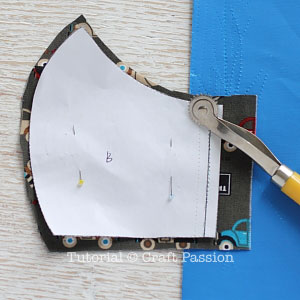
Fold the main fabric into halve with the wrong side facing each other, pin the paper pattern onto the double-layered fabric. Cut the fabric with 1/4″ allowance, except the ear side. Cut the fabric at the ear side with 1″ seam allowance (1.5" if you are using t-shirt yarn as the head tie).
Insert the tracing paper between the layer, trace sewing lines with tracing wheel.
Remove pins and paper pattern, get set to sew.
NOTE: If you are using templates that already have seam allowances included, you do not need to add any more seam allowance. The same applies to the lining in the next step.
Step A-2.

Repeat the same as the main fabric, except the ear side seam allowance. Cut the fabric at the ear side with zero seam allowance.
Step A-3.

Turn the face mask main piece with right side facing each other, sew the centerline of the face mask.
Step A-4.

Clip curve along with the seam allowance, be careful and don’t accidentally clip on the stitches.
Step A-5.

Press seam allowance to one side, topstitch near to the seam line on the side where the seam allowance is.
Step A-6.

Repeat the sewing on the lining part.
Add step C-7 to C-11 if you want to add nose wire to the face mask.
Step A-7.

Flip the lining and place onto the main face mask, align the center seam line, pin and sew the top and bottom lines.
Step A-8.

Turn the face mask right side out. Press seam neatly and topstitch near the edge.
Step A-9.

This is how it looks like from the inside at this stage. The main fabric of the side ear area is longer than the lining piece. This is going to be the pocket of the elastic band.
Step A-10.

Fold in 1/4″ at the raw edge of the side ear, fold again so that the first fold edge is 1/4″ from the lining raw edge.
Sew a straight line down, don’t forget to perform a few back stitches to lock the thread end.
Step A-11.

Measure and cut the length of the elastic band needed (usually around 6″-8″ depending on the size of the face).
Insert the elastic band through the pocket and tie a dead knot to the ends.
Step A-12.

Repeat the same to the other side. Pull the elastic band until the knots are hidden in the pocket.
Wear and breathe normally!
TYPE B - FACE MASK WITH POCKET FOR FILTER INSERT
Step B-1.

Get ready for all the materials as stated in the material list above.
Step B-2.

Fold the fabric with the wrong side facing each other, place the paper template on it, pin.
Cut the fabric out with ⅜” seam allowance (you can use ¼" seam allowance), except the side of the face mask: 1″ for the outer layer (1.5" if you are using t-shirt yarn as the head tie), ½” for the inner layer.
Trace the sewing lines with the tracing paper and tracing wheel.
NOTE: If you are using templates that already have seam allowances included, you do not need to add any more seam allowance.
Step B-3.

Turn the pieces over and pin the pair together with the right side facing each other. Sew the curved lines as shown in the picture.
Draw a line ¼” from the original side sewing line of the inner layer, do the same to the other side of the inner layer.
Step B-4.

Clip the seam allowance about ½” apart. This will let the fabric’s raw edge to stretch without pulling the seam when you turn it right side out. Repeat this on both the outer layer and the inner layer.
Step B-5.

Turn the pieces right side out, press the seam allowance to one side, topstitch near the seam line. Repeat the same to the inner layer.
Step B-6.

Fold the side at the second line drawn next to the original sewing line of the inner layer. Fold the raw edge and hide inside the fold. Topstitch to sew it on. Repeat on both sides of the inner layer.
If you want to add nose wire, add step C-7 to C-11 here.
Step B-7.

Place the inner layer on top of the outer layer, with the right side facing each other.
Sew the top and bottom seam lines.
You may notice that the edge of the inner layer is now ¼” away from the sewing line of the outer layer. If it is not the case, please check if you sewing it correctly in the previous step.
Step B-8.

Clip curve on the seam allowance where the 2 layers meet. Leave about 1/2″ from the ends un-clip.
Turn the face mask right side out. Press seam flat.
Step B-9.

Double fold the top and bottom raw edges of the outer layer (both sides). Topstitch near the edge as shown in the picture. Repeat the same to the bottom seam line.
To make the pocket for the elastic band, fold the side raw edge 1/4″ from the edge, then fold again so that the edge meets the edge of the inner layer.
Step B-10.

Topstitch a vertical line to sew it on. The top and bottom have an opening for you to insert your elastic band.
I added my label while sewing it.
Step B-11.

This is the opening for the filter insert.
Step B-12.

Add elastic bands to the pocket face mask the way you like and it is really to be worn.
TYPE C - FACE MASK WITH NOSE WIRE (WITH OR WITHOUT POCKET)
Step C-1 to C-6: Follow step A-1 to A-6 for a non-pocket face mask, or, step B-1 to B-6 for a pocket face mask (As shown in Video).
Step C-7.

Cut a bias strip of 2” wide and 6” long or use store-bought bias tape if you can find if from the shelf.
How to cut bias strip:
Fold the fabric diagonally, draw a line along the crease of the fold, measure 2” from the line and draw a line parallel to it. Cut the strip into 6” length.
Step C-8.

Fold ¼” from the 2” ends.
Step C-9.

Fold the strip into half, lengthwise.
Step C-10.

Stitch up both ends.
Step C-11.

Align the bias tape along the front top edge of the lining.
Topstitch at the bottom edge of the bias tape.
Do not remove the pins until you pin the main piece to this lining piece.
Step C-12.

Continue to attach the main piece and sew them up into a face mask as shown above.
Step C-13 to C-18: Follow step A-7 to A-12, or, step B-7 to B-12 to complete the face mask.
Step C-19.

Cut a piece of pipe cleaner about 6” long, bend the ends in to make the pipe cleaner slightly shorter than the nose wire sleeve. Insert it into the sleeve. Remove the wire before washing the face mask.
Other options of nose wire are twist tie, florist wire, garden bonsai wire, aluminum, or other hardware wires as long as it can be bent and stays there. If the wire is too thin or soft, twist multiple pieces of them to make a thicker nose wire.
3. WEAR
Insert filter for a pocket face mask

Insert a surgical mask if you are using the face mask as a cover.
Insert a non-woven fabric if you can’t find any surgical maskin the market. I air-dried a piece of the anti-bacteria wet wipe as the filter insert. Throw away the filter correctly and wash the face mask every day.
Disclaimer: this face mask is not meant to replace the surgical face mask.

Insert the medium into the pocket from both openings of the face mask. Adjust it nicely so that the medium doesn’t crumple up.

After the surgical mask is fully inside the cover, push the nose wire of the surgical mask to the tip of the cover, bend the wire a little to follow the curve.

The filter insert must be placed till the tip of the face mask, where the nose position is at.
Different ways to wear the face mask

This is the better way to string the shoelace or cord for the head tie, my video shows the other way round. This is easier to put on and tie, and if you need to take out the mask briefly, just untie the bow to release the mask from your face, the mask will hang on the neck.

If you still prefer elastic band, instead of splitting the elastic band into 2, use the full length and insert through the pockets as shown in the picture, tie a knot and hide the knot in the pocket. The length varies for head sizes and the strength of the elastic band, try with yours to check the best length to cut.

Wear the face mask with the elastic band sits at the back of the head.

Source from here
Komentar
Posting Komentar